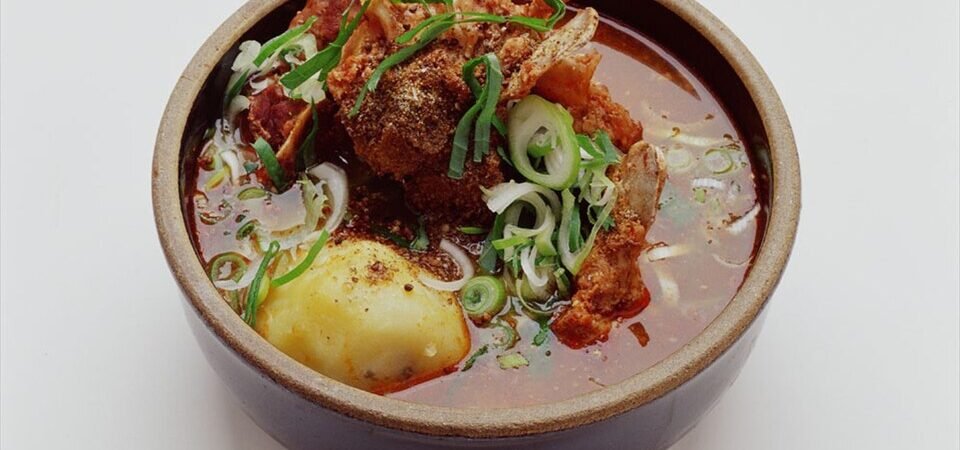
Gamjatang in Seoul is the ultimate late-night comfort food: a big, bubbling pot of pork spine bones, potatoes, perilla leaves and dried radish greens in a spicy, nutty red broth, shared by friends at the table. This guide explains where gamjatang came from, what it tastes like, how much it costs in 2026, and two old-school places in Seoul where locals have been eating it for decades.
What Is Gamjatang?
Gamjatang (감자탕), also called gamjaguk (감자국), is a hearty stew made by simmering pork neck and spine bones for hours until the meat slides off the bone. The broth is seasoned with gochugaru (chili flakes), doenjang (soybean paste), garlic and ground perilla seeds, then finished with potatoes, napa cabbage or siraegi (dried radish greens), green onions and a big handful of perilla leaves.
The result is spicy but not fiery, deeply savory and slightly nutty. You pick the tender meat from the bones, mash the soft potatoes into the soup, and finish the pot by adding ramyeon noodles or stir-frying rice in the leftover broth.
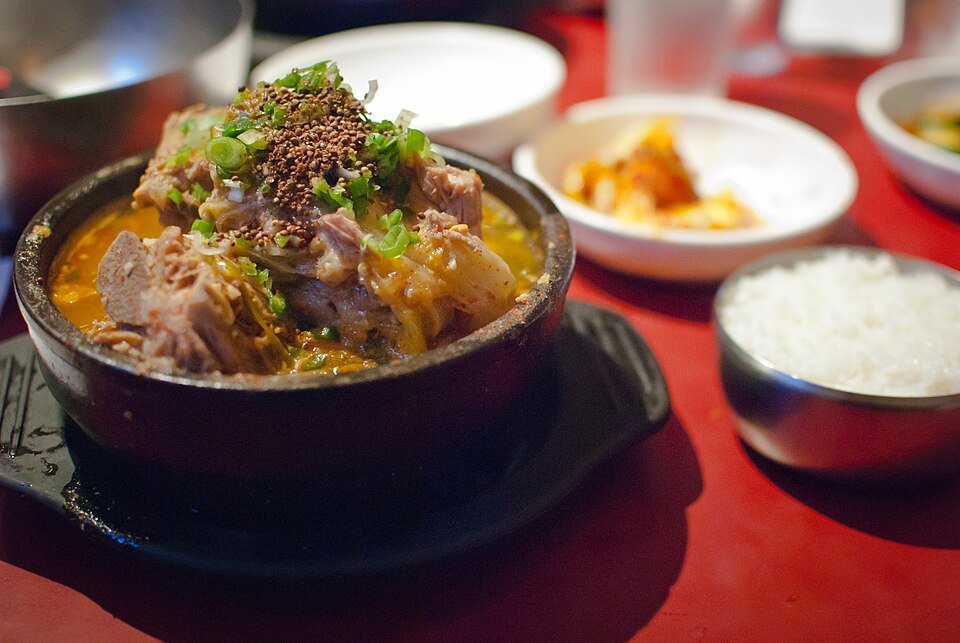
Photo: SteFou! / Wikimedia Commons, CC BY 2.0
The Origin of Gamjatang: Where Did It Come From?
Nobody kept written records of the dish’s birth, so its history is a mix of documented facts and popular stories.
- Cheap bones for hard workers: Pork spine bones were among the cheapest cuts, so a bone stew with plenty of potatoes became filling, affordable food for laborers. A widely told story, retold by Seoul Shinmun’s food columnist, says workers building the Gyeongin Railway (Seoul–Incheon, opened in 1899) ate pork bone soup, and that the modern flavor was perfected in Incheon.
- Post-war Seoul “gamjaguk” houses: After the Korean War, small eateries near markets sold gamjaguk in earthenware bowls. Taejo Gamjaguk, one of our picks below, opened near Donam Market on January 24, 1958, and fed the neighborhood’s workers (Bizhankook).
- Market streets: In the 1970s a whole “gamjaguk street” formed at the entrance of Daerim Market in Eungam-dong, because a nearby slaughterhouse supplied cheap pork by-products (Seoul Media Hub).
- From “guk” to “tang”: In the 1980s many restaurants renamed their “~guk” soups “~tang”, and gamjatang spread through university districts and, later, 24-hour franchise chains across the country.
Why Is It Called “Gamja” Tang?
Gamja means potato, yet early versions may not have contained many potatoes at all. As a result, the name has several competing theories (Seoul Shinmun):
- The spinal cord running through a pig’s backbone was once called gamja.
- Pork spine bones were known as gamja-ppyeo (“gamja bone”).
- The name comes from the Sino-Korean gamjeo (甘猪), “sweet pork”.
- Or, most simply, it was a potato soup to which pork bones were added.
Whichever theory is true, potatoes are now an essential part of the pot, and they soak up the broth beautifully.
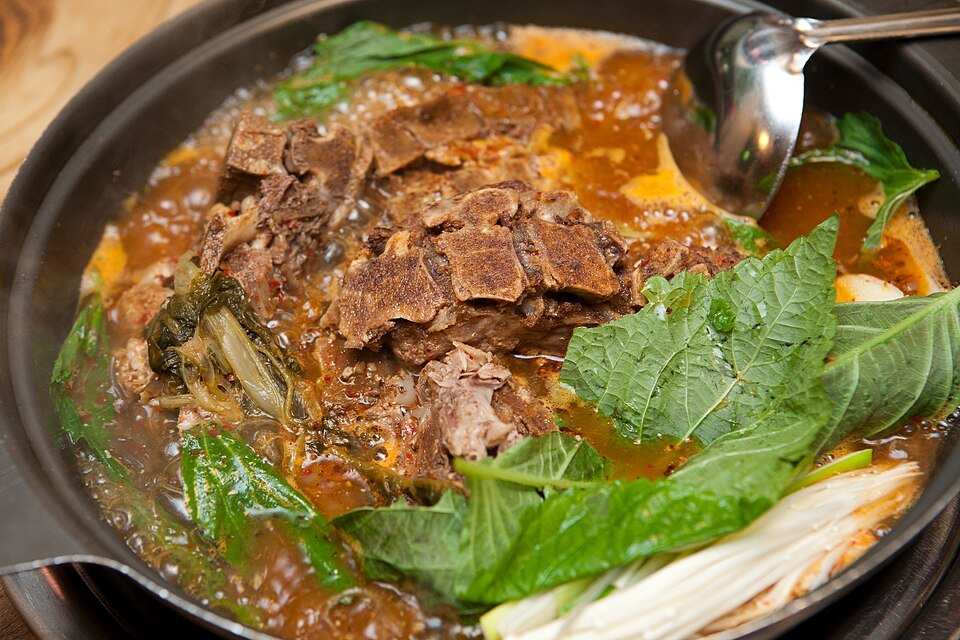
Photo: 국립국어원 (National Institute of Korean Language) / Wikimedia Commons, CC BY-SA 2.0 KR
Why Koreans and Visitors Love It
For Koreans, gamjatang is the classic dish after a night of drinking (it doubles as a hangover cure), a cheap feast for students, and a family dinner on a cold evening. A single-serving version called ppyeo-haejangguk (bone hangover soup) is a popular breakfast and lunch.
For international visitors, gamjatang is a fun, hands-on meal: the pot cooks on a burner at your table, you eat the meat with your hands and gloves, and the ending (noodles or fried rice) feels like a second dish. Moreover, it is milder than it looks, and it is one of the best-value group meals in Seoul.
How Much Does Gamjatang Cost in Seoul (2026)?
| Order | Typical price (Seoul, 2026) | Approx. USD |
|---|---|---|
| Single bowl / lunch (ppyeo-haejangguk) | ₩10,000–12,000 | ~$7–8 |
| Small pot (2 people) | ₩25,000–33,000 | ~$17–23 |
| Medium pot (3 people) | ₩30,000–43,000 | ~$21–30 |
| Large pot (4 people) | ₩35,000–58,000 | ~$24–40 |
| Add-ons: ramyeon noodles / fried rice | ₩2,000–3,000 | ~$1.5–2 |
Prices are based on the current menus of the two restaurants below; USD figures use roughly ₩1,450 per dollar.
2 Best Places to Eat Gamjatang in Seoul
1. Taejo Gamjaguk (태조감자국) — Donam-dong, since 1958
- Address: 1F, 43 Bomun-ro 34-gil, Seongbuk-gu, Seoul
- Map: Kakao Map · Naver Map · Google Maps
- Subway: Sungshin Women’s University Station (Line 4 / Ui LRT), a short walk
- Price: Traditional gamjatang ₩25,000–35,000; siraegi or aged-kimchi gamjatang ₩27,000–37,000; ppyeo-jjim (braised bones) ₩29,000–39,000
- Tel: 02-921-7667 (check hours on Kakao or Naver Map before visiting)
- Why go: Founded in 1958 and certified as a “Baeknyeon Gage” (Century Store, a Korean government program for long-running local businesses), it is one of the oldest gamjatang houses in Seoul, now run by the second and third generations. The pot sizes have playful names — “Joh~da” (good), “Choegoda” (the best) and “Mujinjang” (tons) — and the perilla-packed broth gets richer the longer it simmers. Expect a queue before dinner.
2. Taejo Daerim Gamjaguk (태조대림감자국) — Eungam-dong Gamjaguk Street
- Address: 1F, 172 Eungam-ro, Eunpyeong-gu, Seoul (entrance of Daerim Market)
- Map: Kakao Map · Naver Map · Google Maps
- Subway: Saejeol Station (Line 6), Exit 2, about 800 m (roughly a 10-minute walk)
- Price: Gamjatang small ₩33,000 / medium ₩43,000 / large ₩49,000 / extra-large ₩58,000; lunch bowl ₩10,000; spicy grilled bones (ppyeo-gui) from ₩42,000
- Hours: Restaurants on the street generally open about 10:00–24:00 (varies by shop)
- Why go: Eungam-dong’s gamjaguk street has fed West Seoul since the 1970s, and Taejo Daerim is its best-known shop, with a huge pot piled high with bones. If it is full, its neighbors on the same street — Sigol Gamjaguk, Ihwa Gamjaguk and Bulmat Gamjaguk — serve the same style.
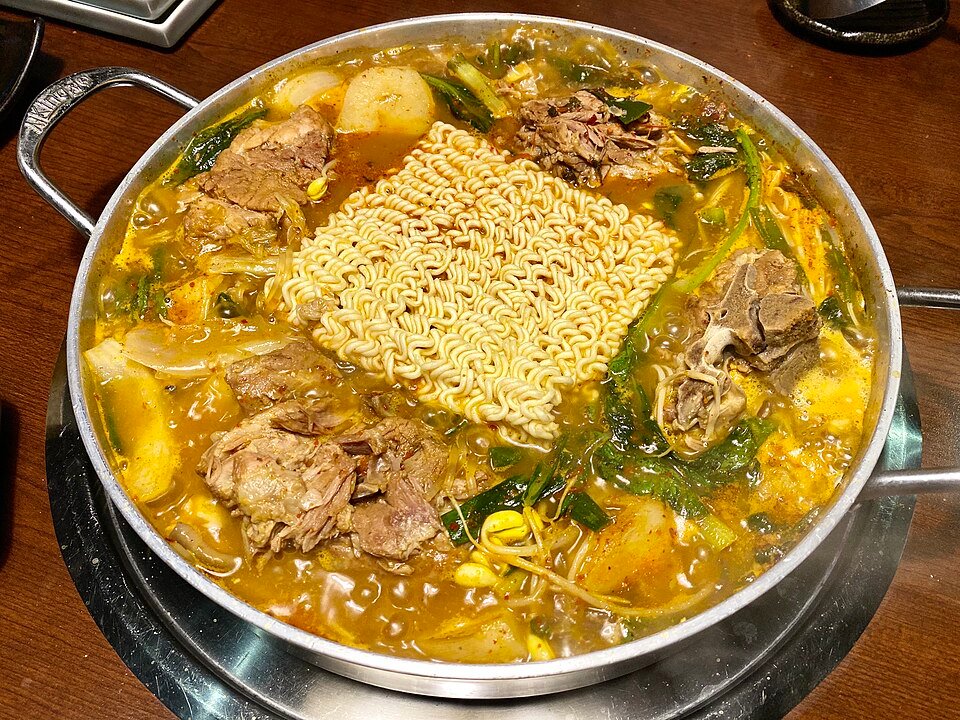
Photo: bryan… / Wikimedia Commons, CC BY-SA 2.0
Ordering and Eating Tips
- Size: Order by people: small for 2, medium for 3, large for 4. Portions are generous.
- Eat in stages: First eat the meat (dip it in the mustard-soy sauce if offered), then the potatoes and greens, and finally add ramyeon sari or ask for bokkeumbap (fried rice) in the remaining broth.
- Use the gloves: Many places provide plastic gloves; picking meat off the bones by hand is perfectly normal.
- Go late: Gamjatang houses stay open late, which makes them ideal after a night out.
Hungry for more? Read our guides to samgyetang in Seoul, samgyeopsal in Seoul and Korean fried chicken in Seoul.
FAQ: Gamjatang in Seoul
Is there potato in gamjatang?
Yes, today every pot includes potatoes. However, the name may not come from the potato: one theory says “gamja” referred to the pork spine or spinal cord.
Is gamjatang spicy?
It is moderately spicy. The chili is balanced by doenjang and perilla seeds, so most visitors find it comfortable.
How much is gamjatang in Seoul?
A small pot for two costs about ₩25,000–33,000 in 2026, and a single lunch bowl about ₩10,000.
Where is the oldest gamjatang restaurant in Seoul?
Taejo Gamjaguk in Seongbuk-gu, near Sungshin Women’s University Station, has been serving gamjaguk since 1958.
Sources
- Seoul Shinmun — Storytelling of dakbokkeumtang and gamjatang (origin and name theories)
- Bizhankook — Taejo Gamjaguk, opened January 24, 1958
- Seoul Media Hub — Eungam-dong Gamjaguk Street history
- Esquire Korea — Seoul gamjatang restaurants (Taejo Gamjaguk, Baeknyeon Gage)
- Polle — Taejo Gamjaguk menu and prices
- Polle — Taejo Daerim Gamjaguk menu and prices
- K-Trip Tips — Eungam-dong Gamjaguk Street
Featured image: Gamjatang, pork-on-the-bone soup with potatoes — Photo: Republic of Korea (Korea.net) / Wikimedia Commons, CC BY-SA 2.0